T-money and the Seoul subway, step by step
LMP 2001 / CC BY-SA 4.0 (Wikimedia Commons)
The Seoul subway is clean, cheap and signposted in English, but the first ride still raises questions. Which card do I need? How do I top it up? Do I tap out on the bus? This guide walks you through it, with fares and passes checked as of October 2026.
Step 1: Get a transit card
You pay for subways and buses with a 교통카드 (gyotong kadeu), a transit card. The best known is T-money (티머니, timeoni). You can buy one at any convenience store (look for the T-money logo at the till) or from machines in subway stations. A basic card costs a few thousand won, depending on the design, and the card price itself is not refunded.
You can also buy a 1회용 교통카드 (irhoeyong gyotong kadeu), a single-journey card, from station machines. It costs the fare plus 100 won, plus a 500 won deposit (보증금, bojeunggeum) that you get back by putting the card into a deposit refund machine at your destination. It's fine for one ride, but a T-money card saves time and money.
Step 2: Top it up
Topping up is 충전 (chungjeon). Two easy ways:
- At a convenience store: hand over the card and cash and say 만 원 충전해 주세요 (man won chungjeonhae juseyo) – "Please top up 10,000 won." Convenience stores generally top up with cash only.
- At a station machine: place the card on the reader, choose the amount and insert notes. Older machines take cash only; newer kiosks that accept foreign Visa and Mastercard are being rolled out, but not every station has one yet.
To check your balance, 잔액 (janaek), place the card on any top-up machine.
Step 3: Tap in, ride, tap out
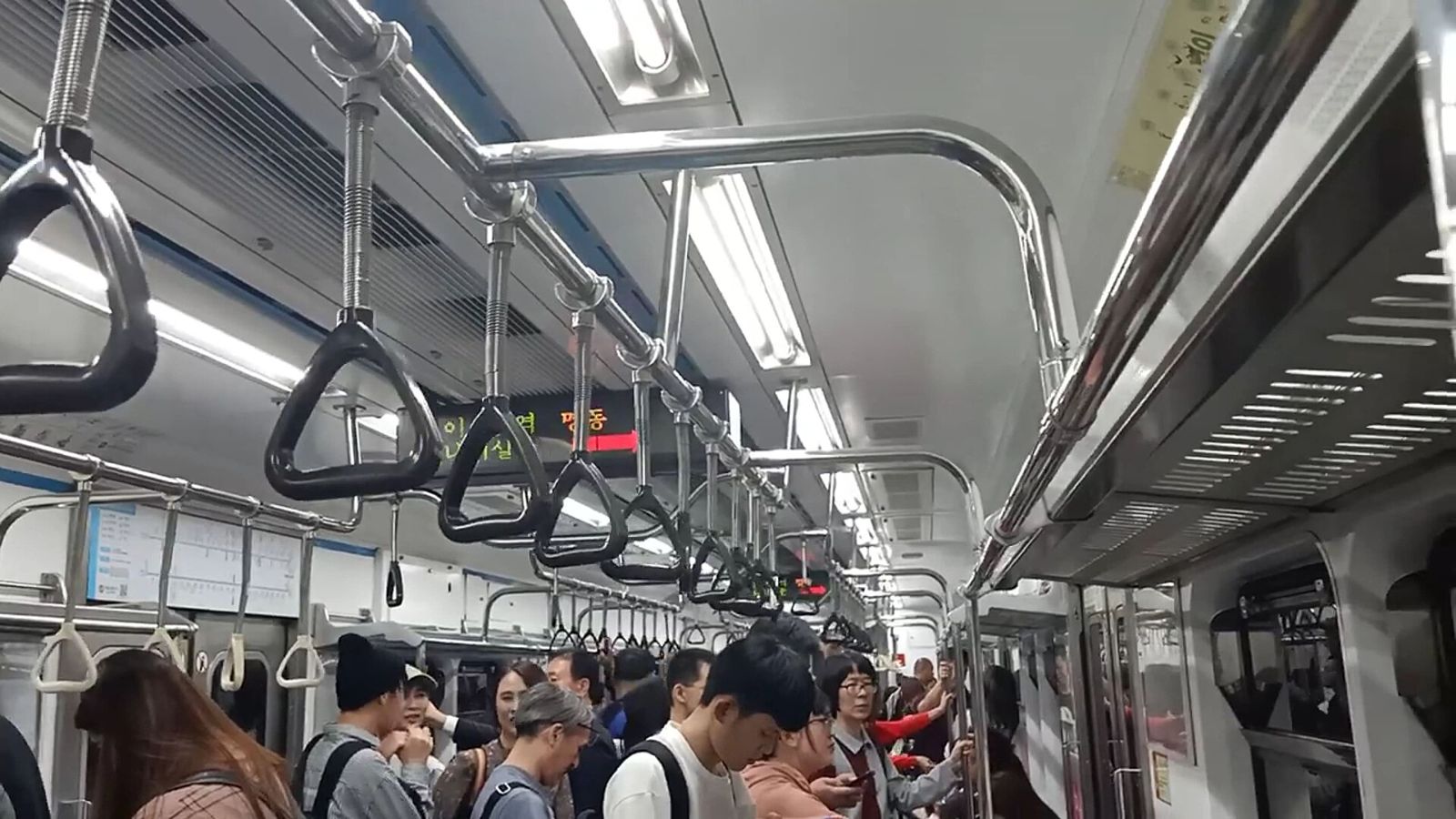
At the gate, tap your card on the reader and walk through. Inside the station:
- Find your line number and colour (Line 2 is green, Line 3 orange, and so on).
- Check the direction: signs show the next station and the end of the line, written as 방면 (bangmyeon), "towards." For example, 2호선 사당 방면 means "Line 2, towards Sadang."
- On the train, listen for 이번 역은… (ibeon yeogeun…) – "This station is…" Announcements are also in English.
- Tap out at the exit gate, then look for your 출구 (chulgu), exit number. Maps and apps usually tell you which exit to use.
What it costs (as of October 2026)
- Adult subway fare with a transit card: 1,550 won for the first 10 km (since June 2025).
- Longer trips: 100 won extra for each additional 5 km, and 100 won per 8 km beyond 50 km.
- Single-journey card: 100 won more than the card fare, plus the refundable deposit.
Step 4: Transfers to buses
A 환승 (hwanseung), transfer, between subway and bus (or bus and bus) within the Seoul metropolitan area is free or discounted if you transfer within 30 minutes (60 minutes late at night). The rule that catches visitors: tap your card when you get off the bus, too. If you don't, the next ride is charged as a new trip.
Tourist pass: Climate Card short-term pass
Seoul's 기후동행카드 (Gihu Donghaeng Kadeu), the Climate Card, offers unlimited rides on Seoul subways and city buses. As of October 2026, the monthly version for residents has been folded into the national K-Pass scheme, but the short-term passes for visitors are still sold:
| Pass | Price |
|---|---|
| 1 day | 5,000 won |
| 2 days | 8,000 won |
| 3 days | 10,000 won |
| 5 days | 15,000 won |
| 7 days | 20,000 won |
A separate physical card costs 3,000 won. The passes are valid only within Seoul, so trips that leave the city, such as the airport railroad to Incheon Airport, are not covered. At about 1,550 won a ride, a pass pays off if you take three or four rides a day.
If you live in Korea, look at K-Pass instead, which refunds part of your monthly fares. Short-term visitors can't sign up for it.
Getting your money back
Leftover balance on a T-money card can be refunded, 환불 (hwanbul), at convenience stores (small amounts) or at designated offices, minus a small fee. Many visitors simply keep the card: it works in other Korean cities and in taxis and convenience stores too.
Korean you can use
| Korean | Romanization | Meaning |
|---|---|---|
| 교통카드 | gyotong kadeu | transit card |
| 충전해 주세요 | chungjeonhae juseyo | Please top it up |
| 환승 | hwanseung | transfer |
| 출구 | chulgu | exit |
| 방면 | bangmyeon | towards (direction) |
| 몇 번 출구예요? | myeot beon chulguyeyo? | Which exit number is it? (polite) |
| 잔액이 부족합니다 | janaegi bujokamnida | Insufficient balance (gate message) |
Once you've done one trip, Seoul's subway becomes the easiest way to get around the city.
 Basile Morin / CC BY-SA 4.0 (Wikimedia Commons)
 kallerna / CC BY-SA 4.0 (Wikimedia Commons)
 moso / CC BY 2.0 (Wikimedia Commons)