Suneung day: how Korea goes quiet for the college exam on 19 November
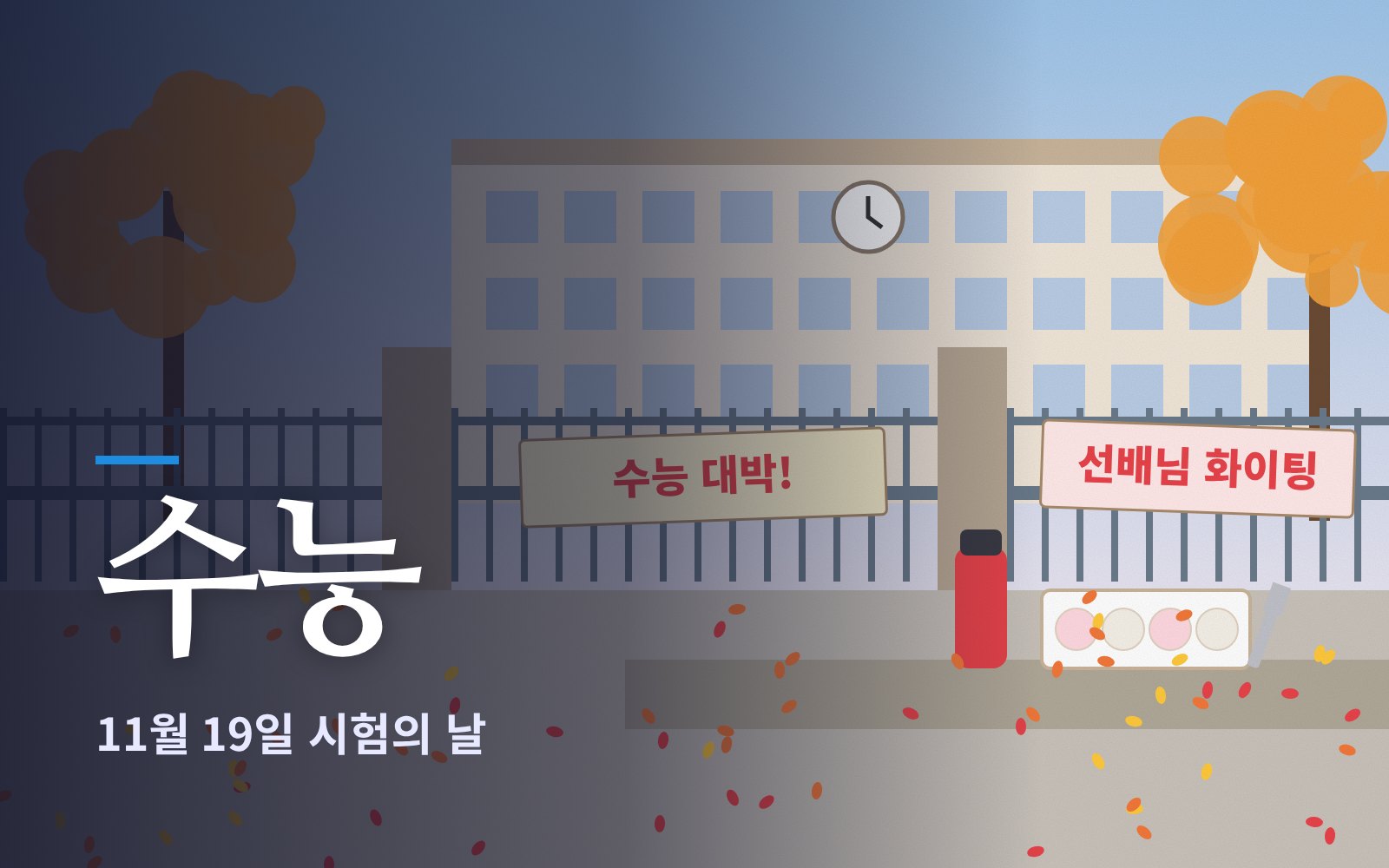
There is one weekday each autumn when a whole country slows down for its teenagers. On Thursday 19 November 2026, Korea holds the 수능 (suneung), the College Scholastic Ability Test, or CSAT. Its full name is 대학수학능력시험 (daehak suhak neungnyeok siheom). It is not a festival in the usual sense, but it comes with its own traditions, foods and greetings, and if you live in Korea you will feel it. Details below are from the Ministry of Education's plan announced on 20 October 2026.
The day in numbers
- Test takers: 551,864 students have applied this year, 2,310 fewer than last year.
- Where: 1,312 test sites in 85 districts across the country.
- When: from 08:40 to 17:45. Students sit Korean, maths, English, Korean history and elective subjects.
- Results: scores are released on 11 December.
This year's exam is also expected to be the last with the current system of elective subjects, because a reform starting in 2028 moves most areas to common subjects for everyone.
How the country helps
The government's measures change daily life for everyone, not just students:
- Late start: public offices and companies are asked to begin work after 10:00, so roads and trains are clear for 수험생 (suheomsaeng), exam takers.
- More trains: Seoul-area subways add extra services between 06:00 and 08:10.
- Police rides: police and local officials run emergency transport for students who are running late.
- No cars near schools: vehicles are kept 200 metres away from test sites.
- Silent skies: during the English listening test, from 13:10 to 13:35, plane and helicopter take-offs and landings are rescheduled. Military firing drills pause too, and buses and trains near test sites slow down and avoid honking.
If you're travelling that day, expect quiet streets in the morning and a possible change to your flight time around lunchtime.
Sticky gifts and slippery soup
Many customs are built on wordplay. To pass an entrance exam in Korean is to "stick" to a university: 붙다 (butta [붇따]). So the classic good-luck gifts are sticky: 엿 (yeot), a chewy traditional taffy, and 찹쌀떡 (chapssaltteok), glutinous rice cakes. Some people give a fork, to "pick" the right answer, or tissues, to "solve" the questions smoothly. Today chocolate, gift cards and vitamins are just as popular.
For the same reason, students avoid 미역국 (miyeokkuk [미역꾹]), seaweed soup, on exam day. Its slippery seaweed suggests slipping, that is, failing.
On the morning itself, younger students gather at the school gates with banners and chants to 응원 (eungwon), cheer on, their seniors, while many parents go to temples and churches to pray during the exam hours.
Korean you can use
| Korean | Romanization | Meaning |
|---|---|---|
| 수능 | suneung | college entrance exam |
| 수험생 | suheomsaeng | exam taker |
| 시험 | siheom | exam |
| 붙다 | butta [붇따] | to stick; to pass an exam |
| 떨어지다 | tteoreojida | to fall; to fail an exam |
| 엿 | yeot | traditional taffy |
| 찹쌀떡 | chapssaltteok | sticky rice cake |
| 응원 | eungwon | cheering, support |
| 듣기 평가 | deutki pyeongga [듣끼 평가] | listening test |
시험 잘 보세요! (siheom jal boseyo!) – Good luck on your exam! (literally "see the exam well"). To a friend or younger student, say 시험 잘 봐! (siheom jal bwa!). Another favourite: 수능 대박 나세요! (suneung daebak naseyo!), "Hope you hit the jackpot on the suneung!"
Sources: Korea.kr – Ministry of Education CSAT day measures (Korean), Kyunghyang Shinmun – CSAT day measures (Korean), Herald Economy – 2027 CSAT plan (Korean), Etoday – the last elective-subject CSAT (Korean), YTN – CSAT gifts (Korean), Gulf News – exam-day rituals